
By Dr Indranil Chakravorty
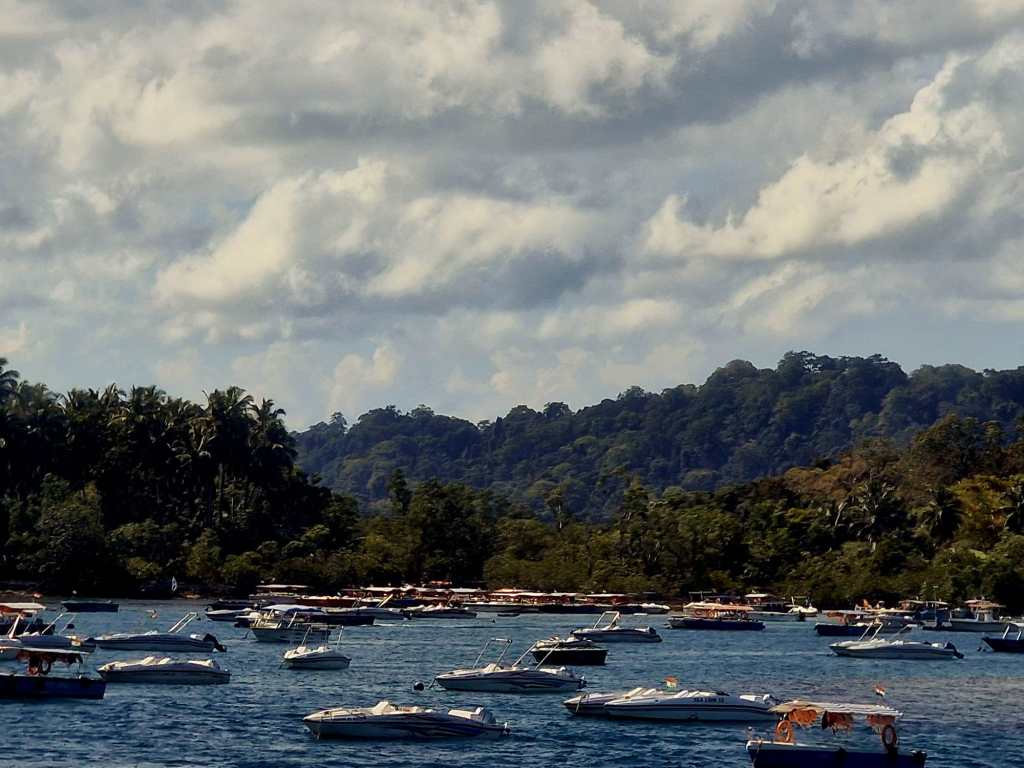
The heavy monsoon clouds lay like a herd of grey cattle on the azure sky. They appeared motionless reflected on the mirror blue green of the Andaman sea. The sun had just set on the horizon but there was still a golden hue highlighting the edges of the cloud formations. Vishal stood on the deck of the Ocean Queen, holding the nearly crumpled soft paper that encircled a wispy finger of tobacco. It had been nearly a year since he had stopped smoking. But he still found the smell of richly roasted tobacco leaves, reassuring. The clouds were part of the returning monsoon and were southward bound. They had a slow but determined pace as they traversed the sky over the Andaman sea. He looked over at the distance screwing up his eyes to visualise the fading dark green outline of Neil island and wondered if she was still there looking over towards him. The Ocean Queen had left Neil and was heading to Port Blair. This was the last voyage of the day and soon the sinewy tendrils of the dark night would replace the glow of the sun. All life comes to a standstill after sundown on Havelock. At least those that are engaged in work. In the resorts dotted along the road to Kalapathar there will be dancing and music. Many candlelit dinners will be laid out, and couples will be holding hands dreaming of happy days to come.
For Vishal, happy days were a thing of the past. His world had just shattered, and thousands of pieces of memory lay scattered on these two islands. Havelock where he had made his home, and Neil where his heart was ventured and lost.
His mind wandered ‘lonely as a cloud’ as he remembered when he had first met Parvin.
“I am a student of human nature”, she was heard muttering when anyone introduced her as an anthropologist. Parvin had qualified from Calcutta University, having started off with her psychology bachelor’s from Presidency. That is where Vishal and Parvin’s paths had crossed and their destiny written. They were both at a Darwinian debate on the origin of species, at the Asiatic Society. He lost the debate, but sweet was the taste of defeat in the hands of such a worthy opponent as Parvin, he remembered thinking at the end of the event. He had reached out to Parvin, to congratulate her and in an awkward fashion asked if she was free for a coffee. Parvin, was amused and intrigued by this young man, who presented a confident self on stage, but was stiff and awkward in his interaction off stage. Vishal could barely look her straight in the eye. He was never comfortable talking to strangers.
Vishal noticed that the Ocean Queen had set off from Havelock with its motley crew and a bunch of weary passengers. He looked around from his perch near the starboard railing. Vishal loved to see how young men and women lovingly came on holiday with their parents or in-laws and managed to care for their needs while listening to the demands of the tiny tots. In his work, Vishal was happy to watch children from a safe distance. That was the only part of his job that he found challenging, screaming children. He found himself unable to think straight when anyone screamed, least of all children. But he admired them when they were blissfully asleep in the safety of their mother’s lap.
Parvin loved children, and children loved her. She was always striking up conversations with all sorts of young humans, even those who could not speak. Vishal hated how she was always distracted when there were children around. Even when he was reciting poetry by the sea or in the lofty heights of philosophical discourse. She was the practical one.
“I have a singular lack of imagination”, she would often say as a matter of fact.
Yet, she was often found happily chatting away with a young girl about three headed dragons or a lad about different species of aliens in space. Vishal, on the other hand, found himself stiff, awkward and at a genuine loss for words or common ground with anyone under the age of sixteen. He was not sure why. Maybe because he was brought up by his grandmother, who, having lost her son and daughter in an event of unimaginable tragedy, protected him like a hawk. He was grateful that she had taken him in.
His grandfather had become mute and a recluse after the event. No one really was allowed to talk about the event in his family and his neighbourhood. These were his ‘Amma’s’ strict instructions. He was two years old when he was left as an orphan in the lap of his grieving grandparents. Over the last two decades he had learnt not to be outwardly curious, but can any child not be curious of what took his parents from him?
The Ocean Queen was now swaying gently as it left the calm of the Andaman sea and traversed the choppy portion of the Bay of Bengal. In a few hours the lighthouse will come into view. This was the part of the journey which he did not like. He was mildly sea-sick, but more importantly he was terrified of the water. He imagined himself sinking to its unimaginable depths and being unable to swim. Vishal had never really learnt the art of swimming. All he was capable of was to cling nervously to the floating device that he insisted on wearing round his waist every time someone forced him to enter the water. Yet, Parvin loved water of all description. She was always seeking water bodies, they made her calm, helped her to focus her mind, stop it from wandering. Parvin never travelled anywhere without her swimsuit. Every morning she would be found cycling to Kalapather beach and be swimming around the rock formations that lined the edges of the beach, out of sight from the section that was popular with the tourists.
There were not many tourists on the Ocean Queen, mainly islanders- those that made a living serving the thrill seekers and honeymoon couples on Havelock. These people should be called the settlers, really if one were to be true to the history of the place. The true islanders were the native tribes that inhabited the islands from the time the first humans moved out of Africa. Vishal was not much into history, so this is all he remembered. Parvin had a passion for history, their genetics and human migration. She was an anthropologist.
‘Doc, would you like to try some samosas?”
Vishal, was shaken out of his reverie by a friendly and respectful approach. He looked at the man who was standing next to him. Dressed in a pristine white uniform with the golden stripes of a first officer, Krishna looked handsome. His well-trimmed black beard stood only a few shades darker than the healthy dark skin that shone in the dying light past the golden hour. Krishna had moved to the Ocean Queen after a few years on a cargo-container ship that plied the sea between Singapore, Calcutta and Vizag. He had a passion for wildlife photography and when he was off-duty, you could always spot him with his Cannon and his 500mm lens. Vishal’s interest was in portraits.
“I am not sure, which is more challenging – finding a wild dolphin willing to pose or a human who was willing to sit in different positions, as you played with the illumination.”
Krishna was no fan of photographing people. He was happy with wildlife as a subject. He could be very patient and wait for hours to catch the right light on the tail of a school of silver fish. Ever since Krishna took up his commission on the Ocean Queen, he had never shied away from striking up a conversation with Vishal. The ‘doctor and the sailor’ was what he had called their friendship. Vishal did not have many friends or people that he could confide in. He had no siblings, and did not really remember any conversations with his parents before they were no more. So, for Vishal this bond that had spontaneously formed with young first officer Krishna was valuable. Rarely do men from different walks of life, who merely share a journey, albeit frequently, find such comfort in each other’s company. To Vishal, Krish was the sibling he never had.
‘No, I am not hungry’, he replied but with a grateful smile.
His lips curled slightly, just enough to match the smile which lit up his light brown eyes. When Vishal smiled, two dimples appeared in his cheeks, which Parvin found utterly attractive. Just the thought of Parvin, made the ache reappear in Vishal’s chest. They were deeply in love, ever since the day they had met in College Street and walked the short distance to the Indian Coffee House.
Their first meeting was a series of round-robin discussions from religious fundamentalism, to patriotism, to rights of the downtrodden in society to Bosons. Vishal found himself drawn into this vortex of an intellectual roller-coaster that would previously have exhausted him, had this been with anyone but Parvin. Parvin had the capacity to reach deep inside him through his eyes. Effortlessly, she could reach in and examine his soul. Vishal, who had grown up to be a private person, however found himself yielding easily and without anguish to Parvin’s examination. Often this was the easiest way for him to be with Parvin. Yield, and you shall receive her intense love. And love was what Vishal needed growing up as an orphan, despite the affection that his grandmother tried her best to shower on him as a hapless child losing his parents as he did at the tender age of two.
‘You always say that, and then have enough space in your stomach to have at least two full meals. I know you well, Vishal. More than I would like to admit.’
Krishna was having none of his denials.
‘Come and join me on the deck for a coffee. The Captain would like to meet you. This is his first time sailing. He is a good friend and you will like him.’ Krishna was not interested in leaving him alone. Vishal drew a last drag from his crumpled cigarette. The deep fragrance of the roasted leaves gave him comfort. How will I tell Krishna about Parvin, he wondered. They had been good friends. He tipped the cigarette over the railing, and into the azure blue sea. And, instantly, regretted this crass act of pollution. It was a habit found rampantly amongst his mates while in Medical College. Sitting on the roof of their hostel, solving the philosophical problems in the world, often far, far away. And at the end tipping their cigarette stubs over the edge of the boundary wall and watching it sail down to the pavement below. Not demonstrating much in terms of civic sense, however this act was found to be liberating and marking the end to an evening of the quintessential Bengali adda. It was a habit that gave him comfort. And, today he needed as much comforting as he could muster.
‘I can’t do this anymore.’ Parvin was never so sure of herself, as she was the day that she said these words. Vishal was engrossed in his thoughts so missed the first time she said it. There was something in her voice that made him stop and look up at her. She stood by the window, her figure silhouetted against the bright light shining through the open window.
‘What?’
‘I think we have to go our own way, from now’, she was calm and composed.
‘I am not sure I understand what you mean. What are you talking about?’ Vishal was becoming anxious now, and when he was anxious his voice tended to become thinner and develop a faint tremor. Then it happened, she just got up and left in her scooter. They were sitting at a cafe and Vishal sat frozen. Motionless in disbelief. He did not see it coming. That is when his ache returned. It was this deep gnawing discomfort in the middle of his chest which lay hanging somewhere too deep from his sternum and not deep enough to reach his spine. Since then this feeling comes back whenever he thinks of Parvin.
He truly loved her but somehow, he should have known that she was not one to be caught or caged in a predictable life. She was like a free spirit. He still loves her even though it is almost a year now since she walked out of that cafe. She never offered an explanation. He could not bring himself to ask her. He knew she would hate him if he had begged her to stay. He didn’t want that.
‘Dr V, It is so good to meet you. Finally, I get to meet the only doctor who came and stayed on this island during its most tragic times.’
The Captain had his hand stretched and Vishal hesitantly offered his and they joined in warm clasp. There was an instant understanding between the men.
‘I was the skipper of a fishing trawler which was moored just off the islands, when it hit us.’
The Captain went on, his hand still clasped with Vishal’s in a warm handshake, his eyes grateful as his gaze met his.
‘There were bodies everywhere and we were picking them up as we brought in our nets’. Vishal kept looking at the Captain, while from the corner of his eye he could see Krishna nodding.
‘But, I was only doing my job,’ Vishal muttered under his breath. It was two days after Parvin had left. He was still on Havelock when the warning came on the morning of 26 December, that a catastrophic Tsunami was on its way and that Neil island was certainly going to be overrun by waves predicted to be over 3 metres high. Vishal had only one thought at that time. Parvin was still on the island. Or at least that is what he thought. They had not spoken since she walked out on him. The next two days were like a haze to him.
Vishal remembers organising a small team of health workers and going over to Neil, they were not prepared for what they witnessed. The whole island was under water and there were bodies everywhere. The small village with around twenty families was totally washed away. The team found no survivors. There was no sign of Parvin. Vishal was not willing to give up. He persuaded a fisherman who had just returned from the sea, to find only water and debris, where his house should have stood. His wife and two children were nowhere to be found. There was no help that came for the first few days. There was no communication. Vishal and Ranjan, the fisherman combed the nooks and crannies of the island and the sea around it. They found people clinging to floating logs, furniture and any debris from their destroyed homes they could find. The survivors were miles away from the island. Most were weak, exhausted, dehydrated and yet clinging for their lives in the middle of the sea with the blazing sun during the day, and star-studded nights. It was strange how after every natural disaster, nature tends to brighten up as if its cobwebs have been washed away. Vishal kept looking, searching, scouring every inch of the sea. It was heart wrenching, reaching for floating human carcases, turning over and checking for life, then occasionally the pure joy of finding signs of life.
Vishal and Ranjan kept up their search and rescue until Ranjan collapsed due to sheer exhaustion. He hadn’t slept for almost seventy-two hours. Neither had Vishal, but he was younger and more used to working long shifts for days and nights while training. They kept going- bringing back people they could find. He set up a makeshift camp in the only high ground that existed on the island. There under the blazing sun, shielded by a shredded tarpaulin sheet, huddled the survivors. Men, women and children as well as their cats. Vishal was wondering how the goats and cattle did not survive but the cats – they truly have nine lives. Ranjan needed to rest. He found it impossible to drag himself up after he recovered from his faint. So, Vishal went alone.
At night when Vishal and Ranjan were scouring the dark waters for human life, the scene looked serene with a boat floating on the navy blue and black sea, the sky held the light from the faint yellow glow from the storm lantern that formed a picture from a dreamy postcard scene. Ranjan, like most fishermen in the Bay, loved singing. He would hum the tune,
‘Kul nayi, kinar nayi, nayi ko doriyar pani, sabdhane chalayio majhi, amar bhanga tori re..’ Vishal would also join in, hoping someone would hear their singing and shout out. By the third night, they would go for hours without finding any sign of life. Parvin was nowhere to be found. When Ranjan could not pull anymore, Vishal went alone. He went into the night with the flickering light from the storm lantern failing to penetrate the haze that was rising from the warm Andaman sea. Vishal was oblivious to the fact that he had never really learnt to swim or survive in the water. All he cared for was the chance to save another hapless human who may be clinging within inches of life and death. And, of course, Parvin. Until he knew what happened to her, Vishal could not allow himself to rest. It was as if he was in a trance, and within this trance he had limitless courage and energy.
The first time Parvin had met Vishal at the Asiatic Society debate, he didn’t make much of an impression on him. She found most men fickle and egotistic, so gave them a wide berth unless she had to interact with some of them. Parvin was petite, even by Indian standards. She kept her hair tied in a bun, which hung just at the level of her neck. She was not a fan of long hair, it was too much of a hassle, but her Ammi refused to allow her to cut her hair into a bob, which was Parvin’s preferred style. Parvin’s full name was Bilquis Parvin, and she was named after her grandmother who was a freedom fighter. Bilquis had joined the Indian National Army and fought alongside Netaji, in Rangoon. She had Ammi (Bilquis Shabnam) when she was only twenty years old, and after the hoisting of the INA flag on Ross Island on December 30, 1943, Bilquis stayed back to defend the island with a small band of soldiers. Parvin did not know who her grandfather was, and neither did Ammi ever talk about her father. Somewhere, Parvin had a suspicion that it may be one of the men in the INA, but that was not important to Bilquis, nor to Ammi.
To Parvin, Vishal was different and over time his persistence in making Parvin love him, had borne fruit. She did not believe in ‘love at first sight’ and such nonsense that is peddled to young and gullible girls. She was not interested until she knew what someone thought, what motivated them and their philosophical inclinations. Hence, Vishal had to bare his thoughts and his soul, (warts and all), before Parvin even considered him worthy of love.
It was almost a year before Parvin even considered that she could allow Vishal to dream of being with her. At this time, the opportunity for an anthropological survey project on the indigenous tribes of Andaman came up and she jumped at the chance to join. The rest as they say is history. Parvin, had to agree that when she approached Vishal with this news, he jumped at the chance to move to Andaman with her. She was taken aback by his uncharacteristic enthusiasm. Vishal’s character was risk-averse. It was during one of their deep discourses that she discovered the real reason for Vishal’s approach to meticulous planning and safety analysis before he considered any moves.
‘Are you sure? You will not miss the chance to apply for a postgraduate course, if you come to Andaman with me?’
Parvin asked while feeling a roller-coaster of emotions coursing through her being. Is it possible that this young doctor would give up the chance to further his career in Medicine for being with her. For once in his life, Vishal was sure and did not hesitate even for a moment, he was delighted that Parvin had considered him a ‘suitable boy’. He jumped at the chance to belong, to be loved.
When they arrived in Andaman in 2003, it was July and the monsoons were raging through the islands. But they found the lush green woods and the dark monsoon clouds refreshing after the smog that Kolkata had become. He arrived for his first clinic with a small carry case in hand which had his essential supplies. A stethoscope bought from the shop across College Street opposite to the main gate of Medical College, a sphygmomanometer silver, with its reassuring corrugated steel box and the green-black of the cuff; a set of 5 syringes, some bandages, 10 vials of Benzylpenicillin, antiseptic lotion in a glass bottle with a tight silver cap and some morphine in liquid form. His medical bag was made of brown cow-hide and bought from Dhaka, but not by him. It belonged to his grandfather Premananda Mondal, who had fled Bangladesh during the 1972 war and escaped instant death to reach Kolkata. Dr Prem, as he was known to his friends, had qualified as a doctor from Dhaka in 1948, the only one from his family to reach the city and dream to become a doctor.
Vishal and Prem had set up in a rented cottage close to the Cellular Jail where Parvin worked and Vishal’s hospital was also close by. Port Blair was another bustling city in the south of the island, while what attracted them was the wilderness and the lush tropical forests. So their stay in Port Blair was short, soon they moved to Neil Island. Unlike the rest of the islands, Neil (named after Brigadier General James Neil of the British East India Company after his so called success in quashing the 1857 Sepoy Mutiny) was mainly meadows and since 1971, when Premanada Mondal and his ilk arrived, was sparsely inhabited. It was the refugees from the Bangladesh war that were settled in the islands and set up their agrarian communities in villages. Vishal’s great-grandfather was one of the community leaders who set up the health centre there. It was an honour for Vishal to come and work there.
But that is all gone now. Parvin spent most of her time visiting the island working with the tribes. She talked of how they remembered her PhD supervisor Madhumala Chattopadhyay who had spent many years working and bringing their way of life to the rest of the world. On Summer evenings, both Vishal and Parvin tended to their small kitchen garden. But the summer of 2004, changed something within her. At first, Vishal didn’t make much of her seeking solitude at the end of one of her field trips. As a researcher, she needed time to think, to read and write in her journal. Vishal, sat by the flickering flame of the lantern and read. He loved Bengali novelists who wrote at the time of the Bengal renaissance.
‘What do you want to eat tonight?’
‘Anything really. I am not that hungry’, became Parvin’s stock reply. At first, she would look up and smile apologetically. Later, she would keep working. At these times, Vishal felt ignored and isolated, even though they were within touching distance of each other. Their cottage was small and only had a table, chair and the easy chair. Parvin was always at the table, her head buried deep within her journal. Vishal on the easy chair, reading and frequently studying Parvin’s hunched figure as she worked away.
‘Is there something that is bothering you?’
‘Not anything in particular’
‘Why are you not talking to me?’
‘It is not always about you, Vishal. You should know better.’
Then the silent would sit heavily between them like a shroud, invisible yet stifling. Vishal longed for the hours of debate and discourse that made their relationship so exciting. But, there was no whimper from Parvin, as she became more recluse. Her field trips became longer and there was an unpredictability about them. Sometimes it was the weather that could be treacherous, and at other times it was the unreliability of the ferries that took her to distant islands.
‘I was worried about you’, said Vishal anxiously tapping his fingers on the table.
‘What is there to worry about? You know I was on a field trip.’
‘But you were supposed to be back a couple of days ago.’
‘You know the ferry broke down and we had to wait for the next one to be chartered.’
‘But you could have sent me a message.’
‘How? You know there is no way to get any messages or letters unless the ferry runs.’ That would be the end of the conversation. Vishal, hurt, isolated, intellectually abandoned. Parvin, apparently non-chalant. At least to Vishal, Parvin’s attitude appeared to be uncaring. He could not understand why. What had he done? What had changed between them? Sitting in the room, pretending to read from his favourite Bibhuti Bhusan novel, Vishal wondered, while gazing lovingly at the figure of Parvin, pen in hand, feverishly writing into her journal. When Parvin worked she barely lifted her head for air.
‘Did you find what you were looking for?’
Vishal looked up, momentarily confused, as the Captain offered him a coffee. He was looking expectantly, as if waiting for Vishal to say something. But what? Vishal, lost in his own thoughts, had clearly not been listening.
‘Does anyone ever truly find what they are looking for?’, Vishal said and instantly regretted saying it aloud. These were his inner thoughts. He had never really worked out his purpose in life nor what he was seeking? With Parvin, he thought he knew. But then, as Parvin folded into her shell, there was again the purposelessness of his life, that Vishal found deeply unnerving. Parvin’s turning left him rudderless, sailing aimlessly. He hated himself for becoming so dependent on Parvin emotionally. He never wanted to be a burden to anyone. Least of all, to Parvin who was the one person, after his grandmother who had shown him love.
Vishal looked outside the window, sipping his coffee. The Captain was busy negotiating his craft between the plethora of boats bobbing near Haddo jetty. The string of lights that marked the coastal properties in Port Blair, were now in view as the Ocean Queen approached the harbour. He remembered when he returned from his first reconnaissance visit to Neil island, trying to find what the neglected health centre needed for supplies. Parvin stood on the jetty waiting for him. Her petite figure was hard to make out in the small group of people waiting for their loved ones, amongst a number of taxi drivers looking for customers. As the ferry got nearer, he saw the blue of her top and the saffron dupatta she loved. It was one that he had bought for her, one of the few things he had bought, and one of the fewer that she liked.
He looked out and his eyes were searching for that familiar figure. That ache in the centre of his chest had appeared again. He now knew what that meant. She was gone. Since that day when the tsunami devastated the islands, Vishal had not found her. It has been almost a year since everything in his life changed. The last memory of Parvin was her leaving with her rucksack on Christmas eve for her field trip.
Christmas did not have the same meaning in the smaller tropical islands, settled by mostly refugees since the war of 1971. Vishal spent Christmas day on his own in the cottage, after joining Father Allan, the local Catholic priest who had moved here from the diocese of Chennai recently, for a midnight mass. Despite much pleading from Father Allan, Parvin had never joined them for any spiritual Sunday gatherings that passed for morning Church sermons. She hated all religious thoughts as an ardent non-believer would. Father Allan had become a friend when Vishal desperately needed a friend. Although he can’t remember if he ever talked to him about Parvin’s changed self, he felt that the priest could read his mind. Vishal found comfort in his Sunday preachings. He found himself sitting on the bench outside the little hut that served as the house of God on Neil island. This was the bench that Allan had installed for those that did not feel up to entering the ‘church hut’ but felt they could benefit from his wisdom. This bench, named ‘journey man’ by Father Allan, was Vishal’s sanctuary since the Tsunami.
The Ocean Queen docked at Haddo Jetty. There was excitement among the few passengers who collected their belongings and walked down the gangplank to shore. There was a slight rolling of the ship against the hard reality of the concrete jetty. The waters at high tide were more animated than what was usual for the port. Vishal, stayed still watching the passengers disembark. The Captain had shut down the large diesel engine, the First Officer was checking that all his passengers had disembarked. The Crew turned to switching off the lights and clearing up. Vishal remained motionless, as if waiting for something to stir within him.
First Officer Krishna and his Captain were carrying something very carefully as they walked down the gangway. From where Vishal was perched he could not see it clearly. The passengers and the taxi drivers had left the jetty. It was only the crew signing off now. Vishal knew the drill of the last ferry to Port Blair. The lights on the Ocean Queen were now switched off. Only the red revolving light on the bridge remained. There was a solitary seagull sitting perched on the railing near him. It was late for the seagull. Most of the birds had settled back home to their nests and little ones at sundown. It was indeed odd, thought Vishal. But there was always the odd one. Vishal knew this well, being the odd one in most human gatherings. He smiled at the seagull, it stayed motionless, watching, waiting.
His glance shifted to the shore, Captain and Krishna were handing something to someone on the shore. It was dark all around but the light from the single lamppost threw harsh yellow light illuminating the trio. Vishal screwed up his eyes trying to see the third person. Then his heart skipped a beat, it was a familiar figure. He instantly recognised the saffron dupatta… He froze, his heart stopped, his thoughts were caught in mid-flight…
‘We have done as you requested.’ Krishna said his voice barely a whisper.
‘I am very grateful’
‘His soul can now rest in peace’, said the Captain.
‘I hope so. I hope Father Allan will help him to find peace.’ Parvin, turned away, carrying the urn, now empty of the ashes. She was pleased she could do this for Vishal. He gave his life for his people. Now he was united with his dreams in his final resting place under the ‘journey man’ where he will remain guiding other lost souls like him.
Dr Indranil Chakravorty MBE is a Consultant Physician in Acute Internal Medicine, Respiratory and Sleep, Director of Medical Education (St George’s University Hospital 2020-25); Educational leader (Deputy Dean, HEE London 2012-20) & Editor in Chief of the BAPIO Journals The Physician and Sushruta. He is passionate about tackling health inequalities (Hon Prof, U Herts) and technology driven innovation. In his free time, he is an author, amateur playwright and musician.
Photo taken by Indranil Chakravorty (2025)


Leave a comment