
By Aria Chakravorty
Aria Chakravorty graduated from Oxford University with a First Class degree in English Language & Literature in 2026. Her interests include post-colonial literature, feminism and LQBTQ+ rights. She is currently working on her first novel.
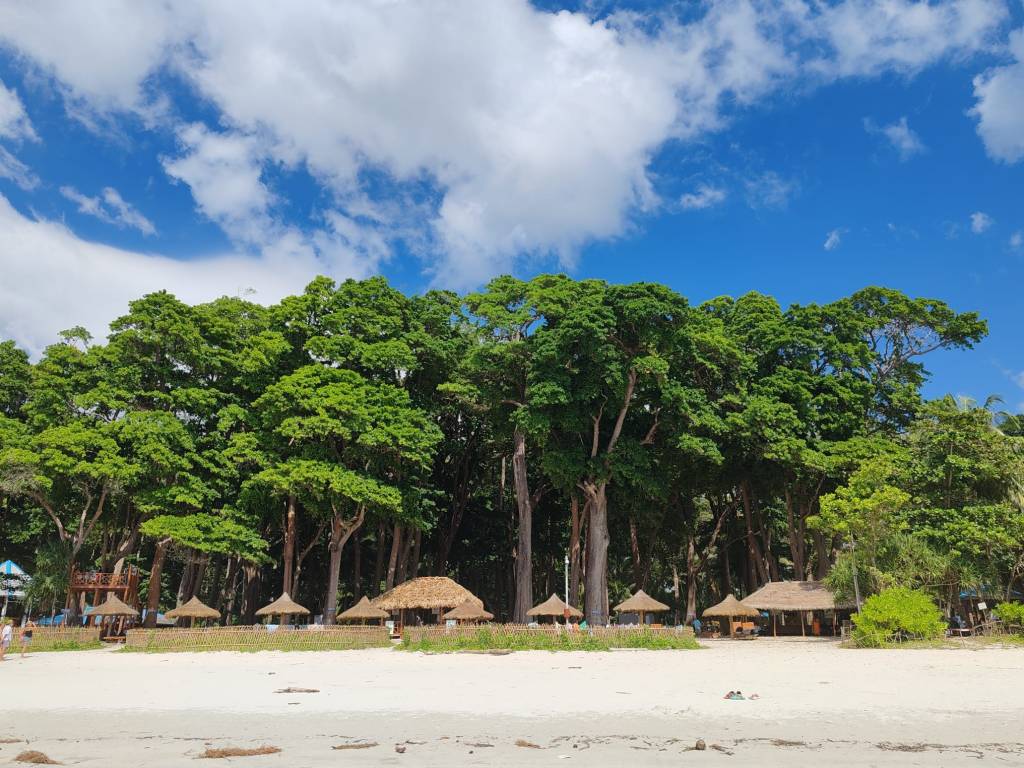
It took a very long time before Ishita realised she was being murdered.
Instead, she was entranced by the world around her. The rising sun soaked the sky in deep orange. Heavy grey clouds hung in low curtains over the ocean. In the corner of her eye, she could see the glimmer of the beach she lay on, bleached of colour until it resembled milk, or bone, the stuff of another world. A pale hermit crab scuttled in front of her face, froze at the bloodstained sand, and hurried away.
Blood – that blood – hers. So that was how she’d died. In the night, her murderers had been faceless, but she could see what they did to her. An arrow to the thigh, a spear to the heart, then, as if paranoid, a knife slit across her throat.
And no pain! That was the most terrifying part. A tiny part of her waited eagerly for the drama of death, the scream as her lungs could take in no breath, the rich gurgle of blood flowing up her throat, every part of her brain lighting up in a supernova of pain. The majesty of self-destruction. Only, there had been nothing. No sensation. And her last hope, the deep, cool waters of oblivion, never came.
Night had turned to day, and Ishita, who had witnessed her own death, was still awake.
It was time she accepted it. Ishita, matter-of-fact in life, was even more stoic in death. Death, for some reason, had not ended her. She searched her brain for her first-year lectures. Afterlife Myths 101. The Catholics had Purgatory. The Greeks had Hades, with its three judges. Her own culture had reincarnation. That was the answer: death wasn’t that easy. There was always a test to pass, to decide whether you moved on, or wandered the margins forever, the ghomta-pora chhaaya of the Tagore song.
As soon as she thought this, she realised she could stand. Ishita rose up, abandoning her body as it soured in the tropical heat. She was on an island. She floated on a long white beach, fringed by impossibly tall trees which beckoned her with their rich shade. Behind her, the sea melted from turquoise, to teal, to mint green, to the final indigo of the depths. Purgatory shouldn’t look like this – it shouldn’t be this beautiful.
So what if she wasn’t in Purgatory? What if she was still on earth? Then it all came back to her. She had come to the Andaman Islands, ostensibly to finish her dissertation, but really to be closer to her mother. She had decided to take a small boat, with nine other holidaying Bengalis, to visit the tiny Ross Island. The storm had come all of a sudden, the sky turning black like a switch had been flipped, everyone at the mercy of the waves. She spun around, and saw the hollowed-out carcass of an orange lifeboat. Of course! She’d been shipwrecked.
But what island was this – with no tourists, no taxi drivers, no farmers? An island where the only help she had received was a quick, clinical murder?
Despite no longer having a body, Ishita began to feel sick. She knew where she was – of course she did. It was the place that had dominated her mother’s work. It had formed her singular obsession. Anything else was a distraction, any other achievement was empty, meaningless. Her earliest memory was of her mother, hemmed in with piles of papers, promising to play with her a little later because she was working on a paper on… North Sentinel Island. That was where she was.
She automatically assembled her reading in her mind.
Forty thousand year old indigenous community… resisted colonisation, globalisation, every form of modern technology… refused to let any outsider interfere with them, even if it meant committing murder…
“Accurate, if a tad melodramatic,” a voice said.
Ishita spun around, and for the second time today, saw something impossible.
It looked like an old man, his skin as deathly white as the sand, with a long beard trailing into the sand. She knew it was not an old man because it was seven feet tall. And floating. Of course. It was one of the… lau, the spirits thought to haunt these islands. They were terrifying figures, not to be trifled with.
The creature nodded as if reading her thoughts. “A keen mind. You are your mother’s daughter.”
It started to slowly circle her, like a predator closing in. She was forced to follow it. “So why are you here? To colonise? To visit a human zoo? Don’t tell me… do you wish to introduce us to Coca Cola? Or iPads?” It laughed, and the sound was like a crashing wave.
“No. Please. There was a storm, I was stranded,” Ishita said with a throat like sandpaper.
“Boating accident. The same excuse as those two,” the spirit said, gesturing down the beach. If Ishita had a heart, it would have stopped. The ghostly outline of a boat floated over the sand, leaving no shadow. The bodies of two men in ragged shirts and sandals floated above it, their skin purplish blue and swollen. Arrows pierced their flesh like thorns. She swore she could hear their low, pained moans.
“But I mean it,” she said, trying to move away, frozen by the creature’s gaze. “Just let me move on. I swear I’m innocent.”
“Do – not – lie to me!” the creature roared, turning red and swelling to twice its size. It scuttled closer on long, crab-like legs. Its breath smelled like rotting meat and pungent seawater. Ishita shut her eyes and waited to be obliterated.
But instead, the creature sank down again. “Very well. If you are telling the truth, prove it. All you have to do is answer one question. If I am satisfied with your answer, your soul may move on. If not, you can join your friends on the beach… forever.”
Ishita knew about deals with the gods. The introduction was only a courtesy – there was no way out of the challenge. She took a deep breath. Like the Sphinx’s riddle, there had to be a solution. She just had to stay calm and work it out.
“Ask me,” she called out.
“Because I have taken pity on you, you may ask anyone on the beach for help.” Even under its beard, Ishita knew the creature was smiling. “My question is simply this: if you could live amongst the inhabitants of this island for one day, what would you do?”
Ishita’s dry eyes could have burst into tears. The question was impossibly vague – how characteristic of an ancient god! What would she do? She could rule out ‘bringing the islanders Coca Cola’; the spirit clearly disapproved of that. What would she do? Fighting the islanders felt wrong.
“Show them the true God. Save their souls,” a voice said, sharply, behind her.
She turned to see a man in a Hawaiian shirt and shorts, wounds leaking from his chest, pulsing a faint blue. No, religious conversion wasn’t the answer. It was too violent, the creature would never accept it.
“Talk to them! Learn their language, record their culture, their religion. Show the world that they are a people with dignity.”
The comment came, surprisingly, from a middle-aged man in a beige shirt, trousers, and wellyboots. His suspenders, his brass pocket watch showed that this man was from another time. Of course – this was Portman. The colonial anthropologist who had spent his life studying the people of the Andamans. She secretly admired him – every bit of language and mythology she knew about them came from this white man. He was the kind of swashbuckling anthropologist, the Indiana Jones, she’d always dreamed of being. Sadly, she did not have the right skin tone for it. She then recalled that Portman also called the Andaman islanders ‘natives’ and claimed they adults had the intelligence of the ‘average young Cockney boy’.
The man politely tipped his hat to Ishita, and she smiled. No, she would not be listening to Portman.
“Have you made your decision?” the spirit said, shivering with anger like the ocean in the breeze. “My patience is wearing thin.”
Ishita turned her thoughts louder to drown out the spirit. Fighting them, changing them, even studying them, these were the answers that had got these ghosts trapped here forever. Maybe she should just trust her gut. She knew what that said: she should approach the islanders with humility and kindness. She would try to form bonds of friendship, as equals.
“That’s my girl. That’s my Rani.”
Ishita felt the strangest thrill. The only person who called her by that name was her mother, who had passed away three months ago.
She looked towards the source of the voice, not believing her ears. But there she was! Her mother, just the way she’d last seen her, in her grey puffer jacket, emerald sari and wire-frame glasses. Silver flyaways around her ears. Ishita felt an overwhelming urge to embrace her.
Her mother, known to the world as Madhumala Chattopadhyay, the first anthropologist to ever form peaceful contact with the North Sentinel Islanders. She was no coloniser. She had approached these people with hope, not expectation, and they’d made an exception for her.
“You know the answer, shona. Just as I taught you,” she said, and her voice sounded so much like her voice, it was truly cruel that she was only a ghost.
“I love you,” she said. “I didn’t say that the last time we talked, and I-”
“I know,” her mother said, with that ghostly calm.
Ishita nodded, and turned to the white spirit. “I am ready to give my answer,” she said. “I would-”
But then, Ishita started to think. Why on earth was her mother here? They said she’d died in a boating accident in Kolkata. There was no talk of her going back to North Sentinel Island.
Ishita started to feel very, very afraid. This shouldn’t happen, she was a ghost, she shouldn’t be able to feel this terror. Her throat was closing up, her heart shuddering impossibly fast.
“Ma?” she said. “Why are you here? How did you die?”
“Calm down, Rani. Focus on the answer. Friendship.”
Ishita rushed forward, circling her mother’s body, and finally saw the arrow sticking out of her back.
Her vision was melting, white stars exploding over her eyes. So her mother hadn’t died on holiday – she’d gone back to North Sentinel Island, she’d been murdered.
Her mother began to tremble, the red from her wound leaching out over her coat, the edges of her body glitching, and suddenly Ishita wasn’t sure if this was actually her mother, or some kind of illusion.
“I was so close,” her mother said. “I pushed them too hard, that was the problem. I got arrogant, I should have taken it slow! If I’d just done a few more reconaissance missions-”
“Ma!” Ishita said, interrupting her because definitely, if this had once been her mother, it wasn’t anymore. Months of being a ghost had twisted her, had bled her of all the human qualities she admired, her love, her patience. She was just an automaton, doomed to repeat the same regrets, the same obsession, over and over for eternity.
Ishita’s mind was running at a thousand miles an hour, flashes of anthropology books, photographs, memories of her mother overlapping as she struggled to put it together. What her mother said could not be the answer. All her mother had been doing was a new kind of colonisation. There was no friendship with a civilisation like this, only bribery, only power. She imagined what might happen if the North Sentinelese had accepted her mother’s friendship. Maybe they would be living in poverty on the mainland, or putting on human safaris for tourists.
“My answer,” Ishita yelled at the seething white creature. “Is nothing! If I had a day to live with the inhabitants of this island, I would do nothing. I would leave as soon as I could. There is no right answer.”
As she spoke these words, there was a terrible howling, gurgling, sound as each of the ghosts on the beach expressed their rage. She realised now that they had never been trying to help her; they had been trying to keep her there. They were too bitter to ever let another person succeed.
Her mother’s gentle sobs, though the quietest of the group, were the loudest in Ishita’s ears. Maybe she could forgive her mother for wanting to keep her there. Maybe she just wanted to spend eternity with her daughter, even if it was an eternity of pain in this hellscape.
The last thing Ishita saw was the spirit’s satisfied smile, then everything seeped away into nothingness, like the whole encounter had been merely stick figures in the sand.
Photo by Aria (2025).


Leave a comment